The United States began vaccinating against COVID-19 on 14 December 2020. Two CDC programs were meant to catch any harm the clinical trials had missed. VAERS takes reports from doctors, patients and manufacturers. V-safe sends vaccinated people text messages asking how they feel. This article follows the paper trail of those two systems from the first week of the rollout into 2022: how many reports came in, how many the contractor could process, and what the public was told.
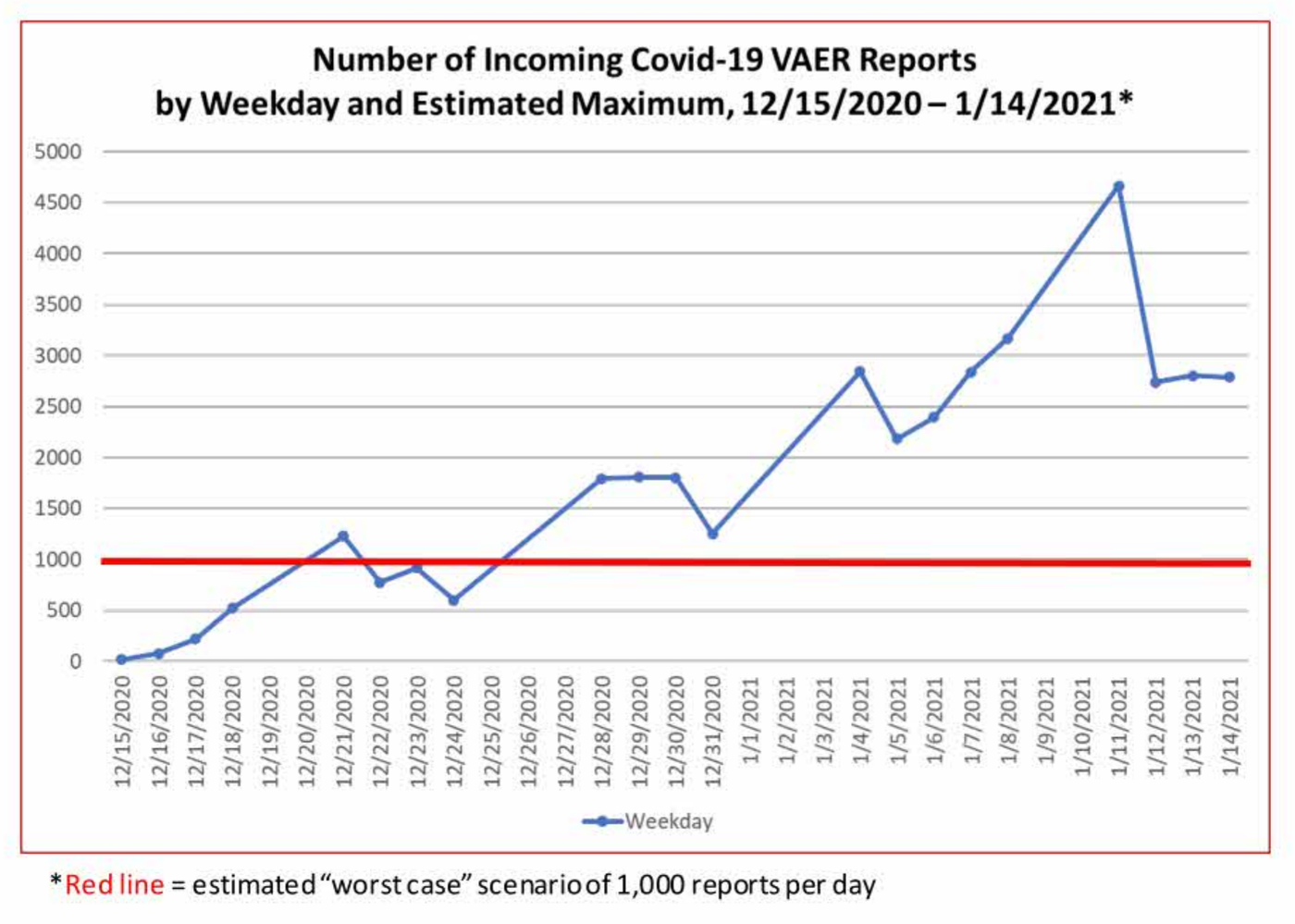
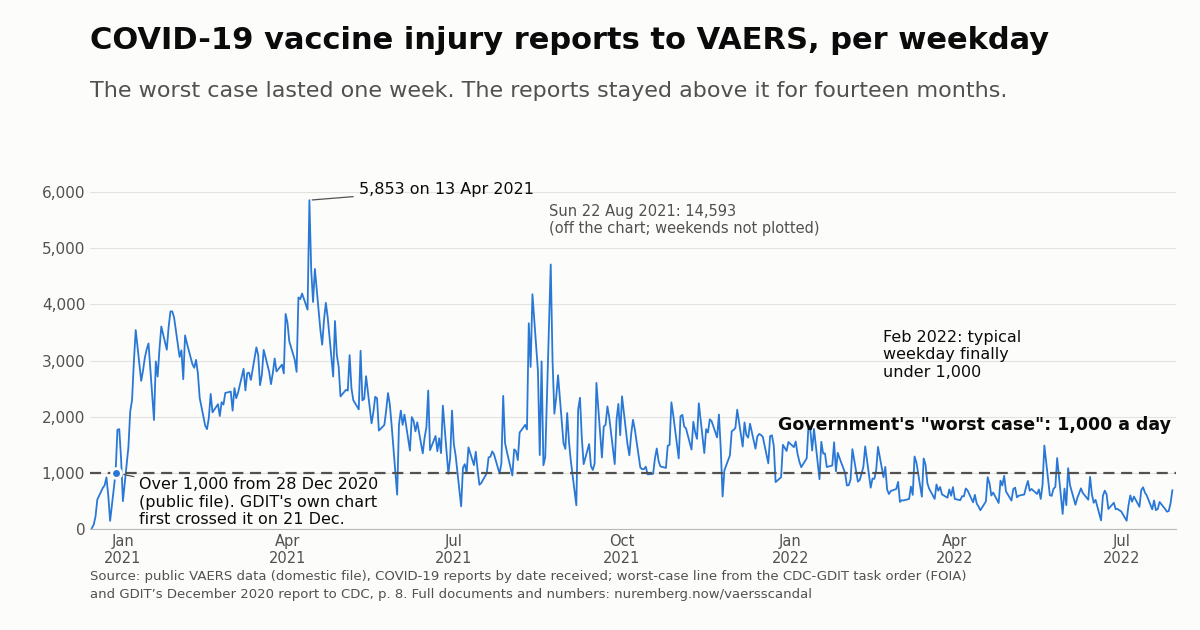
The document that matters most is a monthly report from the contractor that runs VAERS for CDC, General Dynamics Information Technology (GDIT). It covers December 2020 and went to CDC's contracting officer's representative on 16 January 2021, with CDC program staff and an FDA reviewer copied. Its first page carries a chart. A red line marks 1,000 reports a day, which the government's own planning called the "worst case." The reports crossed that line on 21 December, the winter solstice, in the first week of the rollout. They dipped under it for three days around Christmas. From 28 December they stayed over it. The contractor told CDC it was "unable to meet processing and other timeframes (data processing, telephone inquiries, clinical inquiries, etc.)" (GDIT report, PDF p. 8).
They did not come back down. From 4 January 2021 to 31 January 2022, nine ordinary weekdays dropped under 1,000, and the lowest was 790. In February 2022 the typical weekday finally fell under it. The contract had called 1,000 a day a peak "not expected to reflect sustained activity." It lasted fourteen months. Across the 393 days from 4 January 2021 to 31 January 2022, 760,779 COVID-19 reports arrived: 1,936 a day, almost double the worst case. From 8 March to 6 May 2021 they averaged 3,003 a day, three times it. The busiest single day was Sunday 22 August 2021, with 14,593 reports, almost all of them carrying a manufacturer's report number (public VAERS data, counted for this brief).
All that time the public heard something else. Eighteen days after that Sunday, on 9 September 2021, President Joe Biden went on television.
"What more is there to wait for? What more do you need to see? We've made vaccinations free, safe, and convenient. The vaccine has FDA approval. Over 200 million Americans have gotten at least one shot. We've been patient, but our patience is wearing thin. And your refusal has cost all of us. So, please, do the right thing." (Biden, 9 September 2021)
He called the speech "a new plan to require more Americans to be vaccinated, to combat those blocking public health." The plan required vaccination of 17 million health care workers in facilities that take Medicare and Medicaid, all executive-branch federal employees and federal contractors, and, through a Labor Department rule, vaccination or weekly testing for every employer with 100 or more employees, over 80 million workers. The word he used for the vaccines was "safe."
In VAERS, the month of the speech brought 47,172 reports, 953 of them reporting a death and 4,897 a hospitalization. It was not the worst month. April 2021 had brought 103,637 COVID-19 reports, 1,486 reporting a death and 6,800 a hospitalization, the worst month of the year on every count, more than four months before the President asked what more people needed to see.
The public was told "safe" while the contractor's own reports said it could not keep up. The officials accountable, from the President down, are named in Who is accountable below. To read the reports, it helps first to know which two systems they describe.
VAERS is the national system for reports of health problems after vaccination, run jointly by CDC and FDA. Doctors, manufacturers and the public send reports in, and a contractor, General Dynamics (GDIT), enters, codes and follows up on them. V-safe is a separate CDC program, a text-message survey that checks in on vaccinated people every day for the first week, weekly to six weeks, then at three, six and twelve months (ACIP summary report, PDF p. 72). Anyone who reported a health impact was supposed to get a call from the VAERS call center, which would take a VAERS report by phone if appropriate. The report processing and the call line ran under two contracts, and a CDC email of 26 January 2021 names both (FOIA 23-00363, PDF p. 476). The contractor's reports quoted below cover the first. The V-safe call log covers the second, and GDIT's name is the link between them. Section 3 has the detail.
CDC's August 2020 task order planned for 1,000 COVID-19 reports a day at peak and 5,000 a week, "with up to 40% of the reports serious in nature" (FOIA 23-00363, PDF p. 360; original wording in the 27 August 2020 task order, PDF p. 7). The contractor called it "the government's 'worst case scenario' estimate" (FOIA 23-00363, PDF p. 204). No page in the release says where CDC got the number. The only account of method is the contractor's own: it set staffing "with Government guidance" from "previous experiences with high-volume events, such as during the influenza season and during the 2009 H1N1 pandemic surge" (GDIT report, PDF p. 2).
On 29 December 2020 the contractor wrote that VAERS was "consistently receiving over 1,000 Covid-19 reports per day" and asked to loosen the processing deadlines (FOIA 23-00363, PDF pp. 96-97). On 10 February 2021 at 9:39 AM it wrote that it was "unable to process all incoming reports in a timely manner" and that "an ever growing backlog of expired unprocessed reports" stood at "currently over 70,000" (FOIA 23-00363, PDF p. 204). Two days later CDC's contracting officer told it to expect 4,000 to 5,000 a day (FOIA 23-00363, PDF p. 199).
On 22 February Tom Shimabukuro, who led CDC's COVID-19 vaccine safety team, chose the maximum: "We are going with the max amount, 25,000 per week," $21 million (FOIA 23-00363, PDF p. 194). That deserves credit. The staff to use it came later. The March report says "Over 200 staff have been hired and are in training" and that processing of 25,000 reports a week would begin "during the week of April 19th" (GDIT report, PDF p. 18). That is 111 days after the first written alarm.
The federal contract database USAspending.gov shows what CDC committed and when. The VAERS processing order opened at $9,495,102 on 27 August 2020 (award record). It stayed there for the first 74 days of the rollout. On 26 February 2021 CDC added $4,400,699 and on 8 March $16,292,195. The total reached $35,425,642.
The V-safe phone line was a separate order to the same company. GDIT signed it on 30 November 2020, two weeks before the first shots, for $2,302,080 (award record). On 26 January 2021 CDC's contracting officer's representative wrote that "due to substantially higher than expected response" both the processing contract and the call-center contract needed more capacity (FOIA 23-00363, PDF p. 476). The processing order got its money 31 and 41 days later. The call line got an $8,002,777 expansion order on 8 June 2021 (award record), 133 days after that email and 19 days after CDC narrowed the call list to medically attended events. Counting the original awards, CDC had committed $30.2 million to processing reports and $10.3 million to the call line by 13 December 2021, the end of the first year of the rollout.
CDC's own procedure set the clock. The VAERS COVID-19 standard operating procedures of 4 December 2020 give the contractor one business day to fully process a US report of death and start follow-up, three business days for any other serious report, and five for a non-serious one (SOP, Table 4.4, PDF p. 25). Medical records are "routinely requested for all serious reports, including deaths" (p. 10). Footnote 1 lets CDC and FDA change the deadlines for "funding availability." The 29 January 2021 edition keeps the same US COVID-19 figures and adds same-day follow-up for anaphylaxis (PDF p. 27). The 2 February 2022 edition, issued after a year of backlog, keeps them again: one day for deaths, three for serious reports, five for non-serious (PDF p. 21). The contractor's own chart shows a death report received on 25 March 2021 with "no follow up started" 46 days later (GDIT report, PDF p. 24).
On 27 January 2021 Shimabukuro told the government's vaccine advisory committee that for a reported death the contractor "expedites processing of the report (processed the day of report)" and that CDC and FDA physicians review all death reports "as soon as notified" (ACIP, 27 Jan). The same slide ran again on 11 February, the day after the 70,000 letter (partner-call deck). The contract gave follow-up on a death one business day to start (FOIA 23-00363, PDF p. 11). A death report received on 25 March had "no follow up started" on 10 May (FOIA 23-00363, PDF p. 281).
On 1 March he briefed the committee on 104,763 reports through 16 February. The slide footnotes them as "pre-processed." The next slide, the list of the most common adverse events, is footnoted "reports received and processed (coded, redacted, and quality assurance performed)." Divide any count on it by its percentage and you get the same answer every time: about 11,600 Pfizer-BioNTech reports and 5,780 Moderna reports. That is 17,400 of 104,763, one in six (1 March deck, slides 11-12). The contractor's own chart that day counted the backlog at 93,940 reports. It ended March at 79,110 and reached 634 on 29 May (GDIT report, PDF pp. 17, 20, 24). The closing slide told the committee: "No other safety signals for serious adverse events have been detected in VAERS." CDC's summary records one member calling it "what an amazing job CDC is doing" and records no question about the gap (ACIP summary report).
FDA's staff knew. On 12 March Bethany Baer wrote that the contractor's "backlogs, and other outside issues, would be important to consider when looking at this data and may not be widely understood outside of DE" (Senate PSI release, Part 2, PDF p. 162). On 12 April Manette Niu wrote: "As you know, there is a backlog in VAERS reports with the contractor due to the high volume of reports we are receiving for the COVID-19 vaccines and the prioritization of those vaccine reports" (Part 1, PDF p. 29).
The public never got that sentence. The VAERS website said the same thing in February, March, April and May: data appear 4 to 6 weeks after a report arrives, and VAERS is "designed to rapidly detect" safety signals. Four archived copies, no word of volume or delay (22 Feb, 16 Mar, 14 Apr, 13 May). On 11 May FDA's Peter Marks told the Senate: "our safety surveillance systems are doing what they're supposed to do" (Senate HELP, 11 May). On 4 November CDC Director Walensky told it: "We have the most robust vaccine safety system than we have ever had in this Country" (S. Hrg. 117-202).
One state asked, and got a partial answer. On 20 April 2021 Idaho's epidemiology field officer asked CDC whether VAERS had received two reports of myocarditis after second Pfizer doses and whether it saw a signal. On 21 April Elaine Miller answered: "I did not find either of these reports in VAERS yet, but due to processing delays, VAERS may have received them but not processed them yet. To date, CDC vaccine safety monitoring systems have not found evidence of a concerning pattern of reports of myocarditis after COVID-19 vaccination" (FOIA 23-00056, PDF p. 903; Shimabukuro and Su copied). Two days earlier Shimabukuro had written internally: "We don't have any evidence to suggest a signal or safety problem for myocarditis or pericarditis with mRNA vaccines from VAERS and VSD surveillance" (Senate PSI report). Five weeks later CDC drafted a Health Alert Network bulletin on myocarditis. On 26 May FDA's Janet Woodcock wrote to CDC Director Walensky: "do you know that FDA does not concur with issuance of the myocarditis HAN as written?" Walensky answered "Will hold until we chat" (PSICOVID_00005565). CDC posted a webpage on 28 May instead.
The first public acknowledgement of the volume in the sources read for this article came almost three years later, under oath. On 15 February 2024 the House Select Subcommittee on the Coronavirus Pandemic asked FDA's Peter Marks whether the government was prepared for the flood of VAERS reports. He answered: "the avalanche of reports was tremendous. And it, again, required retasking people on the fly" (hearing, PDF p. 17). The word backlog does not appear in his answer. On 12 February 2025 Marks and CDC's Daniel Jernigan wrote that "serious reports were followed up within five days" and that "a backlog of serious reports was cleared within a month and reports of non-serious events were cleared within three months" (FDA Voices). The contractor's chart shows the backlog at 93,940 reports on 1 March 2021 and zero on 30 May (GDIT report, PDF p. 17 and p. 24).
V-safe, the text-message survey, was the other promise. CDC's summary of the 1 March meeting records Shimabukuro describing it: "if an individual reports that they received medical care, that information is transmitted to a VAERS call center, the person is contacted, and a VAERS report is taken if appropriate." In the question period it records "an attempt to contact that person" (ACIP summary report, PDF p. 72 and p. 78).
The call line and the report-processing work ran under different contracts. A CDC email of 26 January 2021 names "the VAERS Covid-19 Surge Contract (200-2020-F-09621)" and "the VAERS Covid-19 Call Center contract (200-2021-F-10131)" and says both needed more capacity "due to substantially higher than expected response" (FOIA 23-00363, PDF p. 476). The monthly reports quoted in this article belong to the first contract. The call log carries GDIT's name, and that name is the link between the two.
Two FOIA files posted by ICAN hold the survey answers and the contractor's call log. 10.09 million people registered. 1.13 million reported a health impact. 47,151 reported a hospitalization, and 15,100 of them have no call attempt on any answer. 23,667 have no outcome recorded. 1,671 completed a VAERS report by phone. Of 105,545 survey answers reporting medical care before 16 February 2021, 63,754 (60.4 percent) show a call attempt and 5,088 (4.8 percent) ended in a report taken by phone. 548,242 answers marked "Unsuccessful" show one voicemail and no second call. The log has no call notes and no transcripts. It is thinnest in the first quarter of 2021, when 54 percent of answers were never called and 15 percent reached a recorded outcome. Those are the months GDIT told CDC, under the separate VAERS processing contract, that it could not keep up.
The people who were not called look like the people who were. Among the hospitalized, 482 never-called people have myocardial infarction coded in their answers, 467 stroke, 283 pulmonary embolism, 72 pericarditis, 36 myocarditis and 28 Guillain-Barre (MedDRA release). The called group has 1,080, 1,027, 661, 158, 77 and 59. Another 1,905 never-called people have COVID-19, 1,006 surgery and 756 pneumonia. The never-called list tracks the called list term for term, and the gaps follow the contractor's capacity.
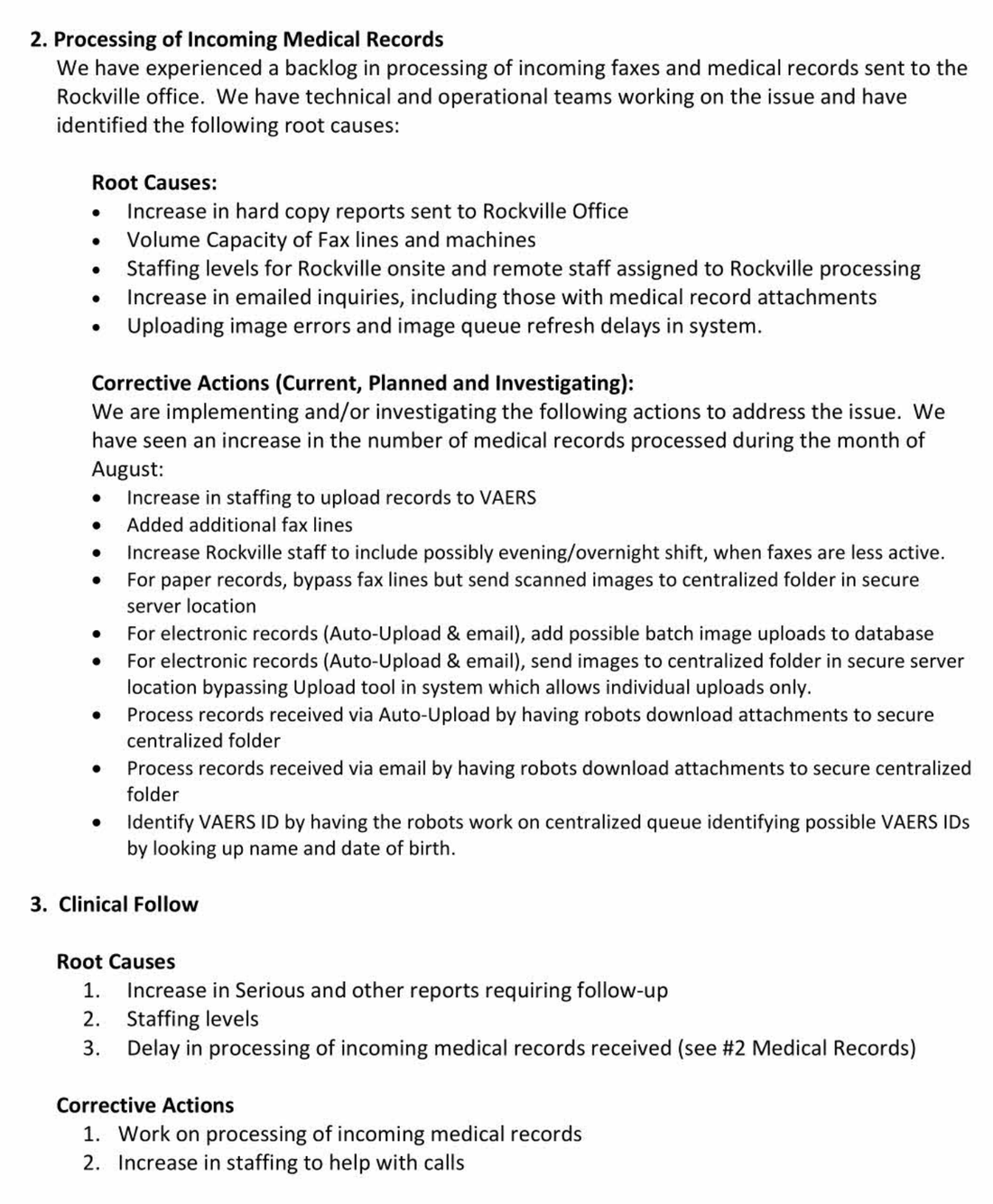
The strain did not end in 2021. From March to July 2022 every monthly report carries the same warning, that the VAERS infrastructure "needs an upgrade," and in March "There is an urgent need for additional storge [sic] and a new server." The last report in the file, for July 2022, adds a section headed "Clinical Follow." Its root causes: "Increase in Serious and other reports requiring follow-up," "Staffing levels," and "Delay in processing of incoming medical records received." The fix it lists is "Increase in staffing to help with calls" (GDIT report, PDF pp. 55, 58, 61, 64, 67-68).
The documents place these officials in the exchange, from the President who told the public the vaccines were safe to the staff who wrote the emails. Each name opens that person's entry in the accountability record: post, chain of command, every dated document linked to its page. The second link, map, opens their card on the map, where the same facts sit beside their other documented ties.
| Post | Who | What the documents show |
|---|---|---|
| President | Joe Biden map | On 9 September 2021 told the public the vaccines were "safe" and asked "What more do you need to see?", 18 days after the record VAERS day. Head of the executive branch that contains HHS, CDC and FDA. |
| White House communications | Benjamin Wakana map | On 25 May 2021 emailed the CDC Director and other health officials a 17-page "tough" Q&A that included myocarditis talking points (Senate PSI report). CDC's FOIA release blacked out all 17 pages. |
| HHS Secretary | Xavier Becerra map | Headed the department that contains CDC and FDA from March 2021, through the whole backlog and the Senate testimony below. |
| CDC Director | Rochelle Walensky map | Told the Senate on 4 November 2021 that CDC had "the most robust vaccine safety system" ever. On 26 May 2021, asked by FDA's Woodcock whether she knew FDA did not concur with the myocarditis alert, answered "Will hold until we chat" (PSICOVID_00005565); CDC posted a webpage instead. Under oath in 2023: CDC reviews every report's medical chart. CDC's own procedure requests records only for serious reports. |
| FDA Acting Commissioner | Janet Woodcock map | Wrote to Walensky on 26 May 2021: "do you know that FDA does not concur with issuance of the myocarditis HAN as written?" and "I just learned that this was about to go out, despite our concerns." Her agency's biologics-center staff wrote the VAERS backlog down in March and April. |
| FDA biologics center director | Peter Marks map | Told the Senate on 11 May 2021 the systems were "doing what they're supposed to do." On 27 May asked Walensky why CDC was posting a page that was "pretty close to the original HAN." Under oath on 15 February 2024: "the avalanche of reports was tremendous." |
| CDC center director (2024-25) | Daniel Jernigan map | Head of the center that houses VAERS when he and Marks wrote in February 2025 that the backlog had been cleared. |
| CDC Immunization Safety Office | Tom Shimabukuro map | Deputy director and lead of the Vaccine Safety Team. Chose the 25,000-a-week surge on 22 February 2021; presented to the public advisory committee on 27 January, 1 March, 14 April and 12 May. On 19 April 2021 wrote "We don't have any evidence to suggest a signal or safety problem for myocarditis or pericarditis with mRNA vaccines from VAERS and VSD surveillance." Copied on the 21 April "processing delays" answer to Idaho. |
| John Su map | The program office's day-to-day VAERS contact with the contractor. Asked it to quantify the backlog on 18 February 2021. | |
| Traci Roberts map | Contracting officer's representative. Wrote on 26 January 2021 that capacity had to rise on both contracts. | |
| Paige Marquez map, Elaine Miller map, Tanya Myers map, Bonita Johnson map | Immunization Safety Office staff on the backlog emails. Miller reported a COVID death report with "no follow up started" 46 days after it arrived, and on 21 April 2021 told Idaho that VAERS "may have received them but not processed them yet" (FOIA 23-00056, PDF p. 903). | |
| CDC response team | Henry Walke map, Abbigail Tumpey map | Walke sent Walensky the draft myocarditis alert on 23 May 2021; she replied "I'm fine with how this reads." Tumpey sent a preview on 26 May with more benefit-risk language (Senate PSI report). |
| CDC contracts office | Philip Denis map (with Nathan Amador map and Lindsey Crockett map) | CDC's contracting officer. Received the "over 70,000" letter on 10 February 2021 and ordered the backlog and surge modifications. |
| FDA biostatistics and epidemiology office | Craig Zinderman map, Manette Niu map, Bethany Baer map | Wrote the backlog down inside FDA on 12 March and 12 April 2021. Colleagues: Jane Baumblatt map, Jane Woo map, Meghna Alimchandani map, Narayan Nair map, Richard Forshee map. |
| Defense Health Agency consultant | Renata Engler map | Told CDC's vaccine safety work group on 12 April 2021 that V-safe offered ten symptoms and could not see cardiac events: "If you do not ask, you will not see it, but does that mean it does not exist?" (Senate PSI report). |
| Contractor | General Dynamics Information Technology map | Ran VAERS processing for CDC and reported the backlog in writing from 29 December 2020. Still holds the VAERS contract, to September 2027. |
Also in the record: Charles Licata map (ordered the EU-origin VAERS fields blanked in November 2022), Julianne Gee map and Frank DeStefano map, the earlier head of the Immunization Safety Office. Contractor staff appear by role in the record and are not given individual map cards.
The people with the most direct line to the public record were Shimabukuro, who briefed the advisory committee, and Walensky, who led the agency and testified to Congress. FDA's half sat with Marks, whose staff wrote the backlog down inside his center. Above them, Becerra headed the department and Biden the executive branch; the President was the public voice for "safe" on 9 September 2021.
Nearly every post at the top of this story has changed hands. Most of the staff who ran VAERS day to day are still listed at CDC. Positions as of 25 October 2026, each from the agency's own page unless marked.
| Post | In 2020-22 | Now |
|---|---|---|
| CDC Director | Rochelle Walensky | Erica Schwartz, MD, confirmed 5 August 2026, 51-44 (NBC News; CDC leadership page, updated 16 October 2026). Before her, Jay Bhattacharya acted from February 2026. |
| CDC principal deputy and chief medical officer | not in the documents | Sean Slovenski, Principal Deputy Director and Chief Operating Officer; Jennifer Shuford, MD, Deputy Director and Chief Medical Officer (CDC leadership page) |
| NCEZID director (the center that houses VAERS) | not named in the documents; Daniel Jernigan by 2024 | Christopher R. Braden, MD, Acting Director, entry dated 15 April 2026 (CDC leadership page) |
| NCIRD director (ACIP's home center) | not in the documents | Rebecca Greco Koné, Acting Director, entry dated 6 July 2026 (CDC leadership page) |
| DHQP director | Denise Cardo, to 2023 | Michael Bell, MD, named on CDC's page dated 16 August 2024 (DHQP director page). No later announcement found. |
| Immunization Safety Office director | Frank DeStefano, 2009-2021 (Wikipedia); Tom Shimabukuro, deputy director in March 2021 and called director by Sen. Johnson in April 2025 | No CDC page names a director. CDC's vaccine-safety page, dated 7 August 2024, names no one (page). A search result for Shimabukuro's CDC biography calls him the former director; the page now redirects to a blog index. |
| VAERS program staff | John Su, Paige Marquez, Elaine Miller, Tanya Myers, Bonita Johnson | Su, Marquez, Miller, Myers, Julianne Gee and Karen Broder appear with ISO affiliations on 2025 and 2026 papers; Su presented three safety updates to ACIP on 18-19 September 2025 (the record). |
| Vaccine-safety presenter at ACIP | Shimabukuro | Mark Blaxill, listed as CDC, presented hepatitis B vaccine safety to ACIP on 4 December 2025 (ACIP summary of that meeting). MSNBC reported in September 2025 that CDC hired him as a senior adviser. |
| FDA Commissioner | Janet Woodcock, Acting | Kyle Diamantas, Acting Commissioner, after Marty Makary resigned on 12 May 2026 (FDA commissioner page, content dated 15 May 2026). No later change found. |
| CBER director | Peter Marks | Karim Mikhail, selected as permanent director on 8 September 2026 after acting from May; he succeeds Vinay Prasad, who left in April (FDA page; AABB). HHS says he will focus on strengthening vaccine safety surveillance (BioPharm International). |
| FDA Office of Biostatistics and Epidemiology | Craig Zinderman, Manette Niu, Bethany Baer, Richard Forshee | Forshee is at CBER on a September 2026 paper. No page names the office's director. |
What to watch.
The V-safe call-log file is named for GDIT, and its outcome codes include "Reported to VAERS voluntarily prior to GDIT contact." That name led me to search for GDIT's part in the system. The search turned up the contractor's monthly reports to CDC. Josh Guetzkow had published them on 21 March 2023, saying an anonymous source had obtained them through FOIA, and Zachary Stieber of The Epoch Times posted the same file on DocumentCloud on 23 March 2023. The first report in the file is dated 15 November 2020, a month before the first shots on 14 December, and the file runs to July 2022. It never mentions V-safe. The connection between it and the V-safe data is the company's name and the dates. Copies of every document cited, and the tables behind the charts, are in the evidence pack; the daily counts are in one CSV file.
Daily and monthly counts come from the public VAERS files for 2020 to 2023, COVID-19 reports by received date, domestic file, as the files stand in 2026. "Reported a death" and "reported a hospitalization" are the flags in each report. The 17,400 figure divides the counts by the percentages printed on slide 12, across ten rows each for Pfizer-BioNTech and Moderna; the rows return 11,538 to 11,651 and 5,760 to 5,798. The contractor's backlog and processing figures are read from the charts on pages 17, 20, 21 and 24 of its report, checked against the page images. The V-safe figures join the two ICAN files on registrant, dose and report date (1,603,206 rows); people are counted once.
Evidence pack: copies of the documents below with original addresses and SHA-256 checksums.
FCHDS · v2026-10-25